

A catalog you can
actually walk through.
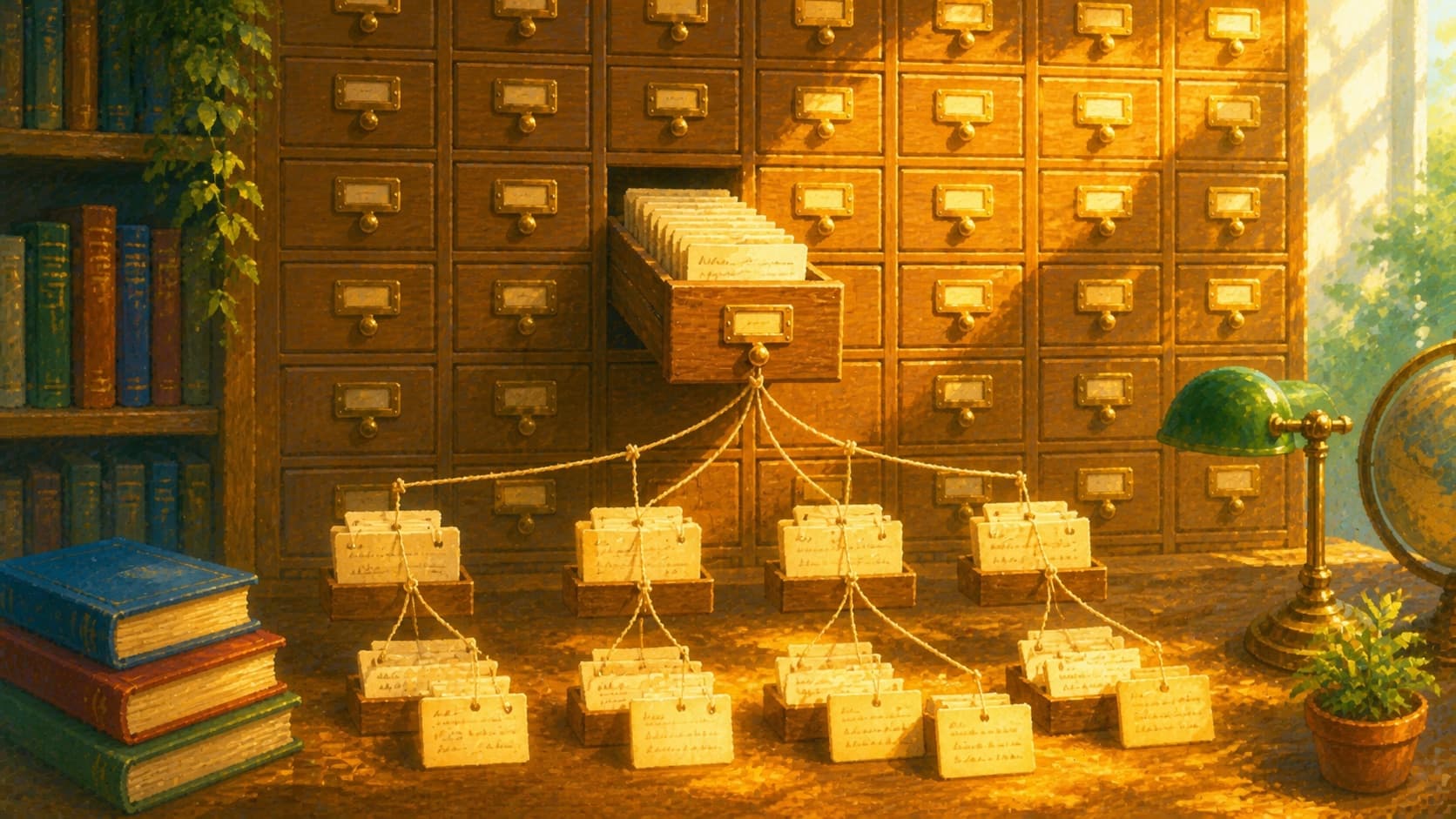
A list this long is useless without an order. The method catalog gives you three ways in: down the taxonomy, across a matrix of families and fields, or along the decades a method was born in.
How is the catalog organized?
Two orders run at once. The taxonomy goes from 7 divisions down to the shelves inside them, and each shelf holds the methods that belong there.
The second order is the one researchers actually think in: the field you work in. The same method can sit on a statistics shelf and still be the one your discipline reaches for, so field runs across the taxonomy rather than underneath it.
- Divisions, then shelves, then methods. Three steps, never a wall of names.
- Every shelf shows its real method count, so a thin corner stays visible instead of being padded.
- Field is a second axis, not a folder. A method can matter to more than one discipline.
The same corpus, seen three ways: the taxonomy that holds it, the grid that measures it, and the decades that produced it. The sections below walk each one in turn.


How do you search a catalog this size?
Before you type anything, the catalog shows you where the mass is. A matrix of families across fields turns the whole corpus into a grid of counts, and every cell is a door: click it and you get exactly the methods that cell counted.
That is a design rule, not a coincidence. The number you read and the list it opens come from the same function, so a cell cannot promise twelve methods and then hand you nine.
- Every cell count is clickable and opens that exact filter.
- Counts and results are computed together, so they cannot drift apart.
- Where there is no data the section is not drawn at all, instead of printing a confident zero.
How far back does the catalog go?
Methods have birthdays, and the spread of them says a great deal about a field. The catalog draws the decade each method was first published in, for whatever scope you are looking at right now.
Everything before 1900 sits in a single bucket, because the alternative was three hundred empty boxes. Methods whose year we do not know are counted and named as unknown, never dropped into a decade that merely looks plausible.
- The strip follows your current filters, so it describes what you are actually looking at.
- Methods with no recorded year are reported as a number, not hidden.
- No year data at all means the strip is not drawn, rather than drawn flat.
Why not just one flat list?
A list this long answers no question on its own. It becomes readable the moment you pick an axis, and the axes are what the catalog adds on top of the names.
- Divisions and shelves you can walk downThe method catalogIncludedA flat list of namesNot included
- Families read across fields as a grid of countsThe method catalogIncludedA flat list of namesNot included
- A decade strip for whatever you filteredThe method catalogIncludedA flat list of namesNot included
- Counts read from the built indexThe method catalogIncludedA flat list of namesNot included
- Methods with no recorded yearThe method catalogCounted and named as unknownA flat list of namesNot included
- A section with no data behind itThe method catalogLeft undrawn rather than shown as zeroA flat list of namesNot included
What does a method page contain?
A page is written to be read from top to bottom: identity first, then the idea, then the practice, then the evidence and the neighbours. These are the real sections, in the order they appear.
Some sections are open to everyone and the deeper ones are for members. Where a section is locked the page says so plainly, on the card, instead of looking empty. See what else the Library does
How current is the library?
Every method record carries a version and date, and the catalog you browse is rebuilt from that index. The count in the header moves when the library moves, instead of sitting there as a figure someone typed in two years ago.
What we do not claim is a schedule. There is no promise of a weekly sweep, because that is an easy thing to print and a hard thing to keep. What the catalog does guarantee is that it never pretends: if the index is missing, a section stays undrawn rather than showing a zero.
- Counts come from the built index, never from a constant.
- Missing data means a section is skipped, not filled in.
- Where the library has nothing to stand on, the answer says so instead of closing the gap.

Questions people actually ask
Pages are assembled from open scholarly records and carry the sources they were built from, so any page can be followed back to what it stands on. The measure we hold them to is whether the page explains the method well enough for a person to use it.
No, and that is deliberate. A corpus this size becomes readable only once you pick an axis: a division, a shelf, a field or a decade. Pick one and the list appears, with the count you clicked matching the list you get.
It is counted separately and named as unknown. The decade strip tells you how many methods it could not place, rather than quietly assigning them to a decade that looks about right.
The identity and the sources are open to everyone. Deeper sections, such as the intuition, the mechanics and the pitfalls, are for members, and a locked section says clearly that it is locked.
Each page carries its related methods, its sources, and a way into chat, where you can ask about the method and get an answer grounded in the pages behind it.

Start with one shelf.
Pick a division, follow it down to a shelf, and watch what the counts do when you click them.
Browse the catalog